

You’re required to provide at least one ADA-compliant porta potty per site, or 5% of total units (whichever is greater), following the 2010 ADA Standards for Accessible Design. Your units must feature a 60-inch turning radius, grab bars that support 250 pounds at a height of 33-36 inches, toilet seats at 17-19 inches, and 32-inch door clearances. Non-compliance risks lawsuits and fines up to $150,000. You’ll also need to verify Arizona state statutes and Phoenix municipal ordinances for supplementary requirements that could affect your legal exposure and operational obligations.
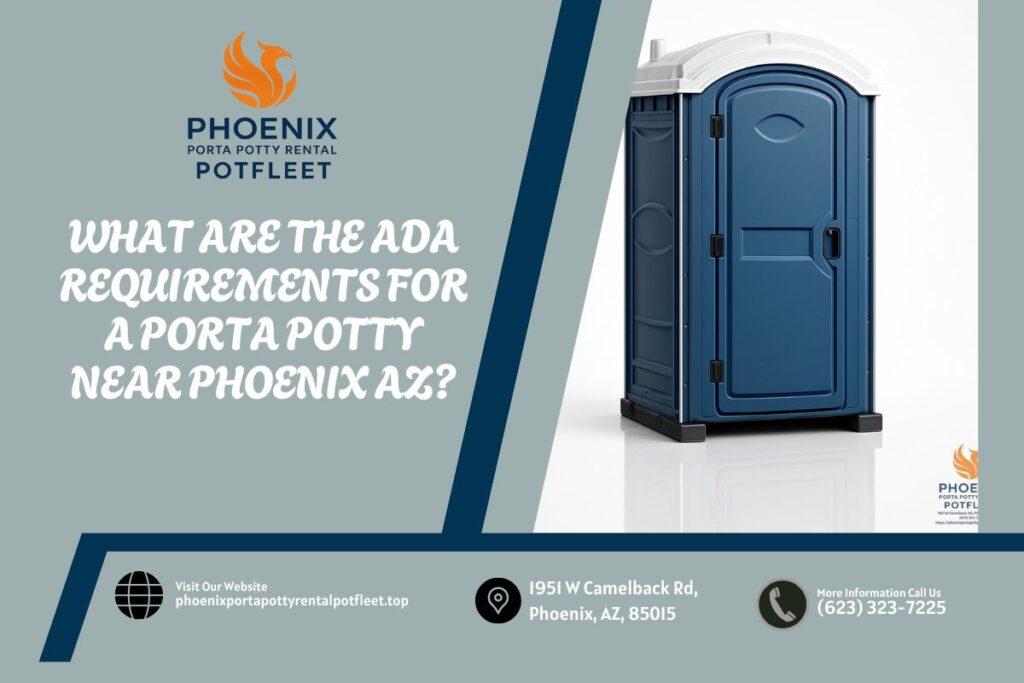
Under the Americans with Disabilities Act (ADA), portable toilet facilities must meet specific accessibility standards outlined in the 2010 ADA Standards for Accessible Design.
You’re required to comply with Section 213.2 and Section 603, which mandate that when you provide portable toilets at temporary events or construction sites, at least 5% must be ADA-compliant (minimum of one unit).
These units must feature 60-inch minimum turning space, grab bars meeting Section 609 specifications, and accessible door hardware per Section 404.
You’ll face potential liability under Title III if you’re a public accommodation or Title II for government entities.
Non-compliance risks include lawsuits and fines of up to $75,000 for initial violations and $150,000 for subsequent violations.
Phoenix contractors must verify that their rental provider supplies certified ADA-compliant units.
See also: ADA compliant portable toilet rental service in Phoenix
The 2010 ADA Standards for Accessible Design establish a precise formula: when providing portable toilet facilities, you must confirm that at least 5% of the total units are ADA-compliant, with a minimum of one accessible unit required, regardless of the total count (Section 213.2).
Calculate your obligation correctly:
Non-compliance exposes you to Department of Justice enforcement actions, private lawsuits under Title III, and potential damages ranging from $75,000 to $150,000 per violation (42 U.S.C. § 12188).
Phoenix Porta Potty Rental PotFleet confirms mathematically precise compliance for every event.
When federal law mandates ADA compliance, you’re bound by exacting dimensional specifications that determine whether your portable toilet meets legal standards.
The 2010 ADA Standards for Accessible Design (36 CFR Part 1191) require a minimum 60-inch turning radius inside the unit, allowing wheelchair users unrestricted movement.
You’ll need grab bars positioned 33-36 inches above the floor, capable of supporting 250 pounds of force. The toilet seat height must fall between 17-19 inches.
Your door’s clear opening width must be at least 32 inches, and you’re prohibited from installing spring-loaded hinges that automatically close.
Non-compliant units expose you to Department of Justice enforcement actions under Title II and Title III.
Phoenix Porta Potty Rental PotFleet configures every ADA unit to these specifications, eliminating your regulatory exposure.
Beyond interior dimensions, structural integrity requirements impose extra compliance obligations that directly affect your liability exposure.
The 2010 ADA Standards for Accessible Design require that accessible portable toilets have stable surfaces that can support individuals using mobility devices without deflection or structural compromise (§§ 305.3, 403.3).
You’re legally required to guarantee:
Non-compliance with these structural specifications exposes Phoenix Porta Potty Rental PotFleet to potential lawsuits under Title III provisions.
Although door width specifications might appear straightforward, failure to maintain the mandated 32-inch minimum clear opening width when measured between the door’s face and the opposite stop creates immediate Title III violations (ADA Standards § 404.2.3).
You’ll face enforcement action if hardware, hinges, or door components reduce this clearance.
Ramp access requires a maximum slope of 1:12 (8.33%), with landings having a minimum depth of 60 inches (§ 405.7).
You’re legally obligated to provide edge protection preventing wheelchairs from slipping off ramps (§ 405.9).
Surface requirements mandate slip-resistant materials with maximum openings of 0.5 inches (§ 302.3).
Your ramp handrails must extend 12 inches beyond top and bottom junctures (§ 505.10).
Non-compliance exposes you to Department of Justice penalties, private lawsuits, and construction delays that restrict your operational independence.
Interior space compliance failures constitute the most frequently cited ADA violations in portable restroom facilities, with the Standards mandating an unobstructed 60-inch diameter turning circle or T-shaped turning space within each accessible unit (ADA Standards § 304.3.2).
You’re legally required to maintain this clearance throughout the rental period.
Critical spatial requirements include:
Non-compliance exposes you to Department of Justice enforcement actions, private lawsuits under Title III, and statutory damages reaching $75,000 per initial violation (42 U.S.C. § 12188).
When positioning ADA-compliant portable restrooms, ensure that accessible routes connect the units to building entrances, parking areas, and event facilities, as required by ADA Standards § 206.2.4 and § 402. These routes require firm, stable, slip-resistant surfaces with maximum slopes of 1:12 (§ 405.2).
| Requirement | Standard |
|---|---|
| Route Width | Minimum 36″ clear (§ 403.5.1) |
| Surface Grade | Maximum 1:48 cross slope (§ 403.3) |
| Door Clearance | 32″ minimum opening (§ 404.2.3) |
| Ground Surface | Firm and stable within 60″ (§ 305.3) |
You’re liable for non-compliance penalties reaching $75,000 for initial violations and $150,000 for subsequent violations under 42 U.S.C. § 12188. Position units on level ground to maintain interior accessibility features and prevent operational failures that compromise user independence.
Beyond physical setup requirements, site selection determines your compliance exposure under ADA Title III regulations (42 U.S.C. § 12182).
You’ll need to position accessible units on firm, stable surfaces with compliant routes from parking areas and facility entrances, as specified in ADAAG Section 4.3. Your path of travel must maintain a minimum 36-inch clearances without exceeding 1:12 slope ratios per Section 4.5.2.
Critical placement factors include:
Non-compliance creates litigation risk under 28 CFR § 36.501, potentially triggering injunctive relief and awarding attorneys’ fees.
Unless you’ve installed proper directional signage that meets International Symbol of Access standards, as outlined in ADAAG Section 4.30.7, you’re exposing your organization to discrimination claims under 28 CFR § 36.303(c).
Your pathways must maintain 36-inch minimum width under ADA Standards Section 403.5.1, with firm, stable surfaces complying with 302.1.
You’re required to guarantee zero-slope cross grades exceeding 1:48 per 403.3, protecting wheelchair users from lateral instability.
Remove all protruding objects above 27 inches per Section 307.2—overhead hazards create liability.
Your signage must display tactile characters between 48 and 60 inches from ground level, as specified in 703.4.1.
Phoenix Porta Potty Rental PotFleet verifies compliance through documented site surveys, eliminating your regulatory exposure.
Non-compliance triggers DOJ enforcement actions, including retrofitting costs and compensatory damages under 42 U.S.C. § 12188.
While accessible porta potties eliminate architectural barriers, your failure to maintain them per ADA Standards Section 213.2 and ADAAG 603 triggers Title III violations under 28 CFR § 36.211, which mandates operational facilities at all times.
You’re personally liable for non-compliance when maintenance lapses create hazards:
Document your maintenance schedule religiously. Courts don’t accept “temporary” non-compliance defenses under United States v. Days Inns of America, Inc.
Regular inspections aren’t suggestions—they’re your shield against costly litigation and your users’ right to safe, dignified access.
Although ADA compliance primarily focuses on accessibility features, your sanitation failures also create supplementary violations under Title III’s “full and equal enjoyment” mandate at 42 U.S.C. § 12182(a).
You’re legally required to maintain ADA units at standards that prevent health hazards that disproportionately affect disabled users. The ADA Standards for Accessible Design don’t specify cleaning frequencies; however, courts have ruled that inadequate maintenance constitutes a discriminatory denial of services under 28 C.F.R. § 36.202.
You’ll face enforcement actions if waste accumulation, supply depletion, or structural damage renders accessible features unusable. Phoenix’s extreme temperatures accelerate bacterial growth, demanding more frequent servicing than DOJ’s suggested 72-hour intervals.
Document your cleaning schedules, because you’ll need evidence proving consistent maintenance if complaints arise. Your freedom to operate depends on meeting these baseline sanitation obligations.
Beyond maintaining sanitary conditions, you must implement specific safety features that protect individuals with disabilities from injury-related liability under ADA Title III’s “safe harbor” provisions at 28 C.F.R. § 36.406.
These features directly reduce your exposure to personal injury claims while ensuring compliance autonomy.
Required safety installations include:
These protective measures shield you from costly litigation under 42 U.S.C. § 12182 while maintaining operational independence from government oversight.
Operating in Phoenix subjects you to layered compliance requirements that extend well beyond federal ADA mandates, as Arizona Revised Statutes § 41-1492.02 incorporates Title III standards while Maricopa County’s improved accessibility ordinances impose supplementary obligations under County Code § 2-148.
You’ll face intensified enforcement during peak construction seasons when inspectors conduct site audits without prior notice. Phoenix’s extreme temperatures create additional liability exposure—ADA units lacking proper ventilation systems violate both 28 CFR § 35.151 and Arizona’s reasonable accommodation standards.
Municipal permit denials occur frequently when contractors underestimate the 5% accessible unit ratio required for events with more than 50 attendees. Documentation proving compliant placement, anchoring specifications, and maintenance schedules protects you from citations ranging from $500 to $10,000 per violation under Maricopa County’s escalating penalty structure.
How do you verify compliance when Phoenix’s multi-jurisdictional framework requires simultaneous cross-referencing of federal ADA standards, Arizona state statutes, and Maricopa County ordinances?
You’ll need a systematic approach to avoid penalties and project delays.
Your compliance verification process should include:
Phoenix Porta Potty Rental PotFleet maintains updated compliance documentation, ensuring your rental meets all jurisdictional requirements without administrative burden.
Different venue types trigger distinct ADA portable toilet requirements under federal and local enforcement frameworks. You’ll face specific ratios and placement mandates depending on your site classification.
| Site Type | ADA Unit Ratio | Regulatory Authority | Non-Compliance Penalty |
|---|---|---|---|
| Public Events | 5% minimum (DOJ) | Title II, ADA 2010 Standards | $75,000-$150,000 initial violation |
| Construction Sites | 1 per 20 workers (OSHA) | 29 CFR 1926.51 | $15,625 per citation |
Construction sites must provide accessible units within 500 feet of work areas per OSHA 1926.51(c). Event organizers can’t restrict ADA units to remote locations—you’re legally obligated to verify equivalent proximity and access routes. Phoenix municipal code 18-13 reinforces these federal standards, creating dual liability exposure for non-compliant operators.
You’ll typically pay 15-30% more for ADA-compliant units compared to standard porta potties, though exact pricing varies by rental duration and features. We recommend obtaining written quotes to guarantee compliance with applicable accessibility regulations and avoid potential liability.
You should reserve ADA-compliant porta potties 2-4 weeks ahead to guarantee availability and regulatory compliance. During peak construction seasons or special events, book earlier—limited ADA inventory creates liability risks if you’re caught without required accessible facilities.
Yes, you can have ADA porta potties delivered to remote desert locations, though delivery fees increase with distance and terrain difficulty. Confirm your site meets ADA placement requirements (level ground, firm surface) per 2010 ADA Standards for Accessible Design.
Yes, you’ll typically receive volume discounts for extended ADA-compliant rentals. Phoenix Porta Potty Rental PotFleet offers competitive long-term rates while maintaining full Title III compliance, giving you cost-effective accessibility solutions without regulatory risk or compromise.
You’re responsible for damages beyond normal wear and tear, as per your rental agreement. Document the unit’s condition immediately and contact us. We’ll assess whether repairs are needed and bill accordingly, though liability terms vary by contract.





© 2026 Phoenix Porta Potty Rental PotFleet. All Rights Reserved.